Configure Your FoldRivet Rack

Step 1 — Configure Angles


Step 2 — Configure Beam Depth


Step 3 — Configure Beam Length


Step 4 — Quantity & Price

Total: -

Note: Transport cost and taxes are calculated at checkout.

How to determine the appropriate
rack dimensions for your facility?

  • Wall to Rack Clearance — Maintain a minimum gap of 200mm between the rack and adjacent walls to allow for placement of the pallets with an overhang of 100mm.
  • Aisle Clearance — Aisle spaces should be in accordance with the specifications of the material handling equipment in operation.
  • Side Clearance — Ensure at least 100mm clearance on exposed rack sides.
  • Safety Margins — Allocate a minimum clearance of 200mm around designated handling zones to accommodate safe operations.
  • Determining the Rack Height Needed: A clearance of at least 150 mm must be maintained between the top of the rack and the ceiling. Where goods extend beyond the rack height, ensure a minimum 150 mm clearance between the top of the goods and the ceiling.
  • Structural obstructions: In cases where building columns or pillars are positioned within the storage area, initiate a new run with a main bay. Racks should not be continued around the obstruction, as the residual space created is non-functional and cannot be effectively utilised. Even if you do manage that, the space is not utilisable, hence that rack is useless there.

Floor Clearances Needed

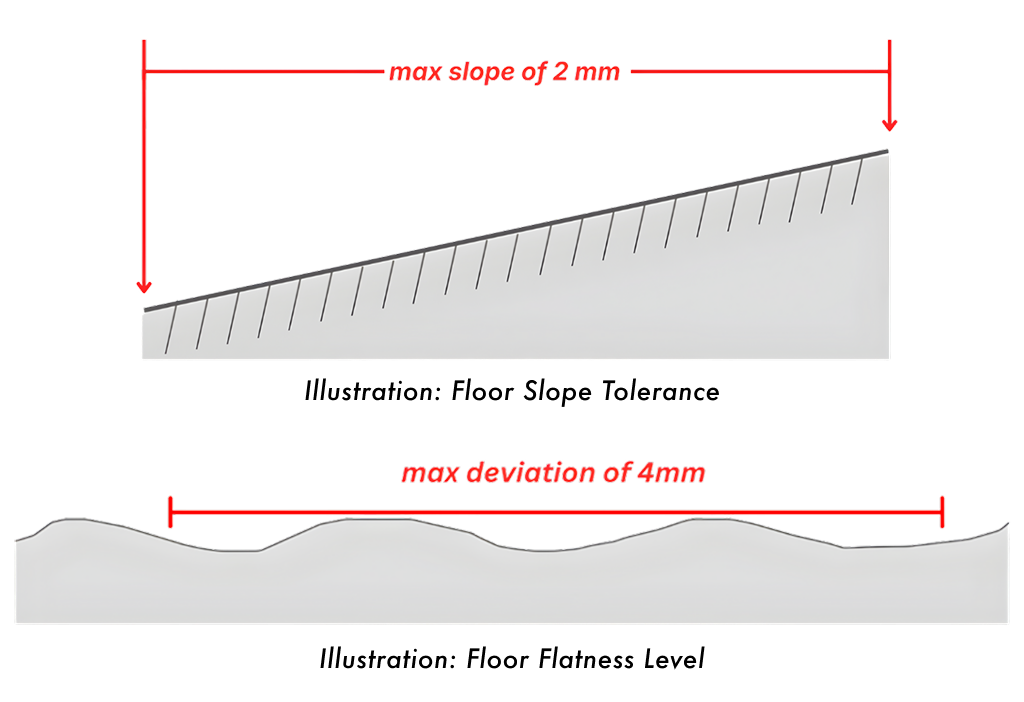
Floor Level Tolerance:

  • General flatness: Maximum deviation of 4 mm, measured over any two survey points.
  • Floor slope: Maximum 1 in 500 (≈2 mm per meter).
  • Levelling shims can and should be used during installation to adjust minor unevenness,  but the floor should already be reasonably flat before installation.

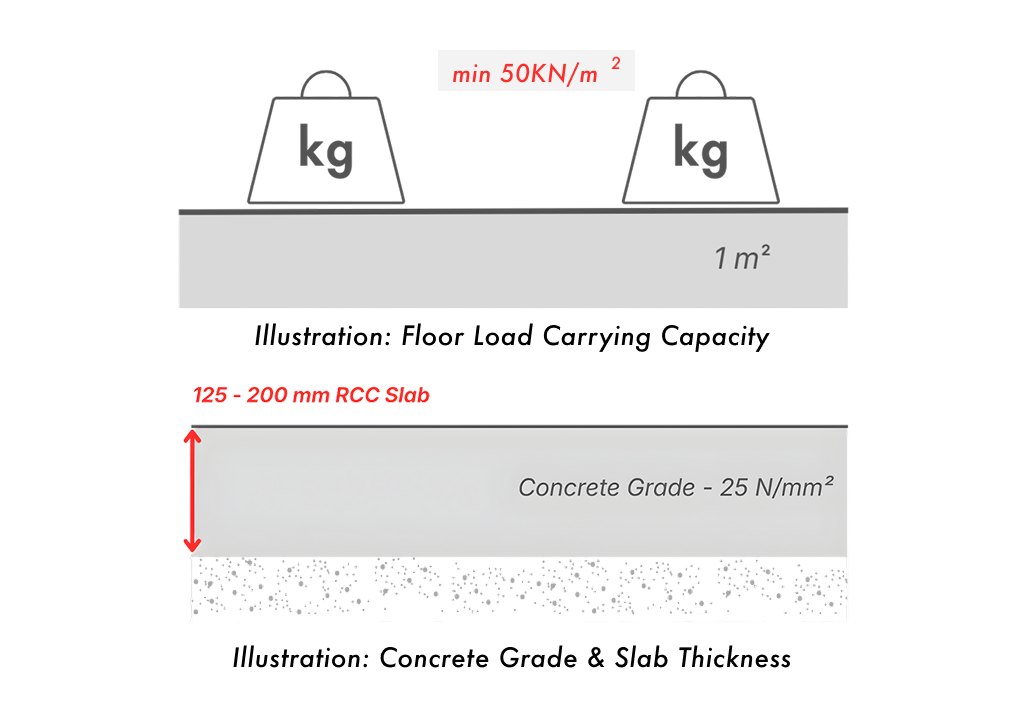
Floor Load Capacity:

  • Requirement: Floor should withstand at least 5.0 ton/m² (50 kN/m²) for Storix PalletMax racks.
  • Point loads: Each upright leg generally carries 4-5 tonnes, depending on rack height, beam load, and configuration.
  • Concrete grade: Minimum M25 (25 N/mm²) is recommended.
  • Slab thickness: Typically 125–200 mm RCC slab with or without reinforcement mesh, designed considering rack loads plus forklift traffic or any other material handling equipment (MHE) used.

The Main Bay & the Add-on Bay

The Main Bay:

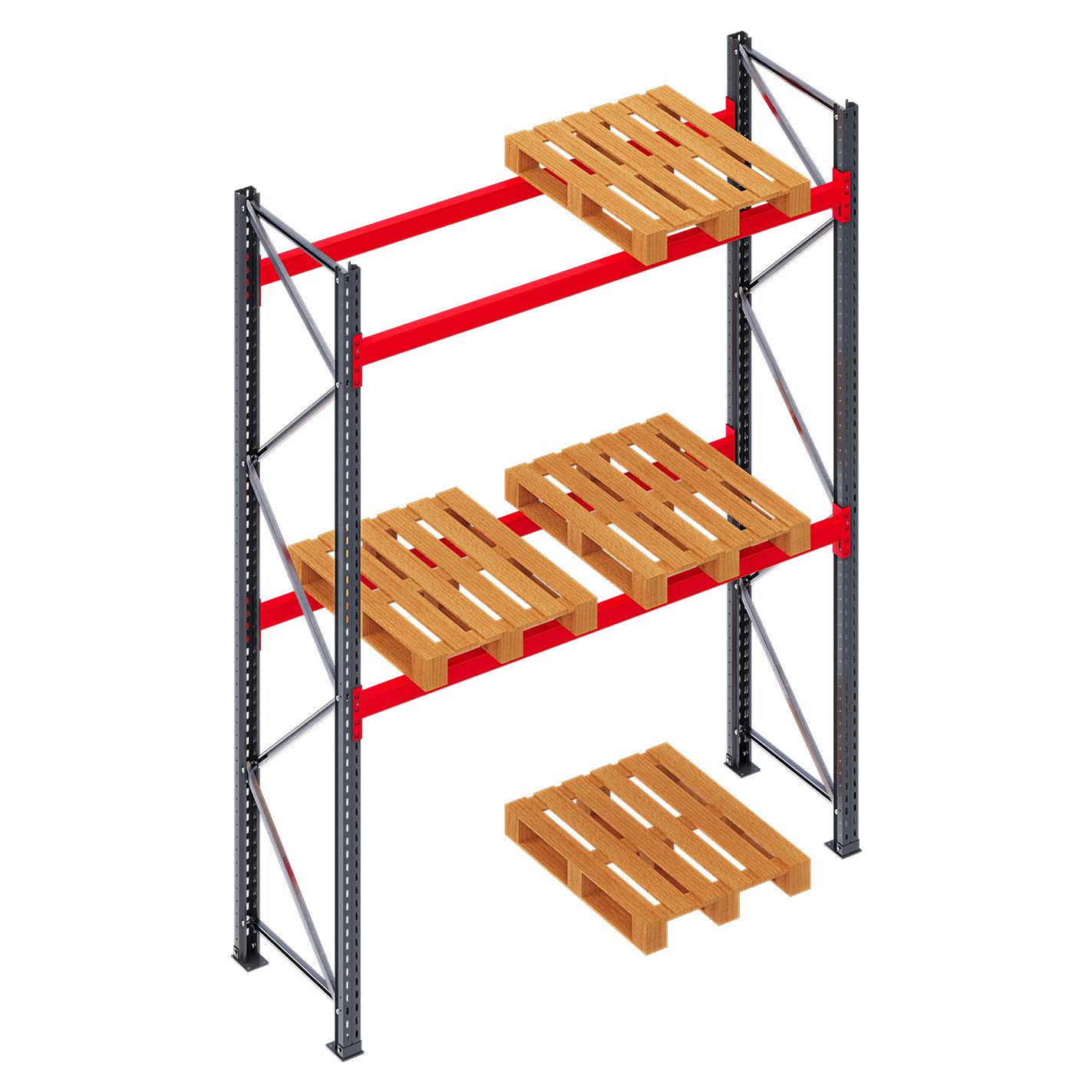
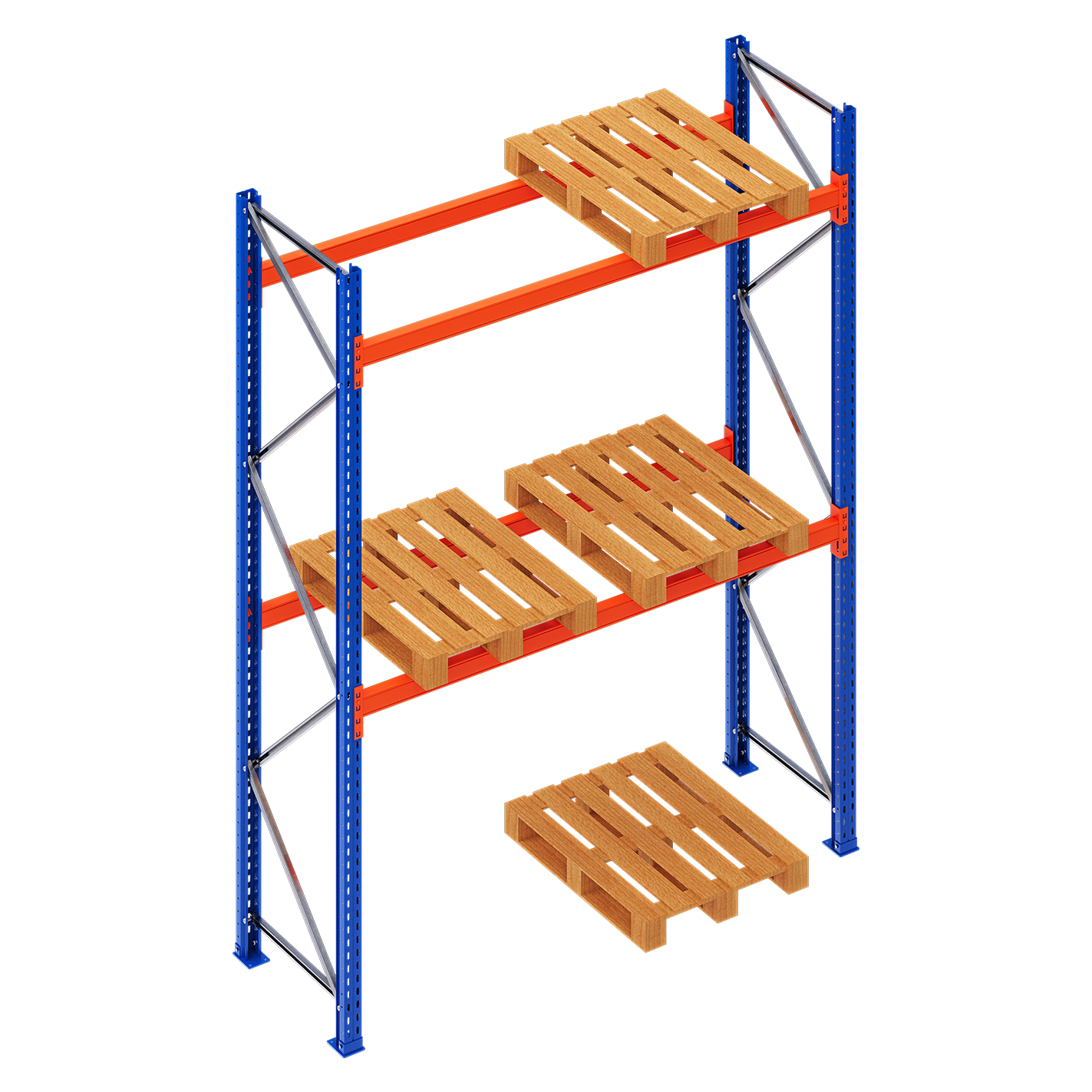
Often referred to as the Starter Bay, this unit is a complete rack section made up of two upright frames connected by a full set of beams. It can function independently as a single unit or serve as the starting point for a continuous row of racks. From the Main Bay, the system can be extended as needed, with the help of various compatible accessories and components.

The Add-on Bay:

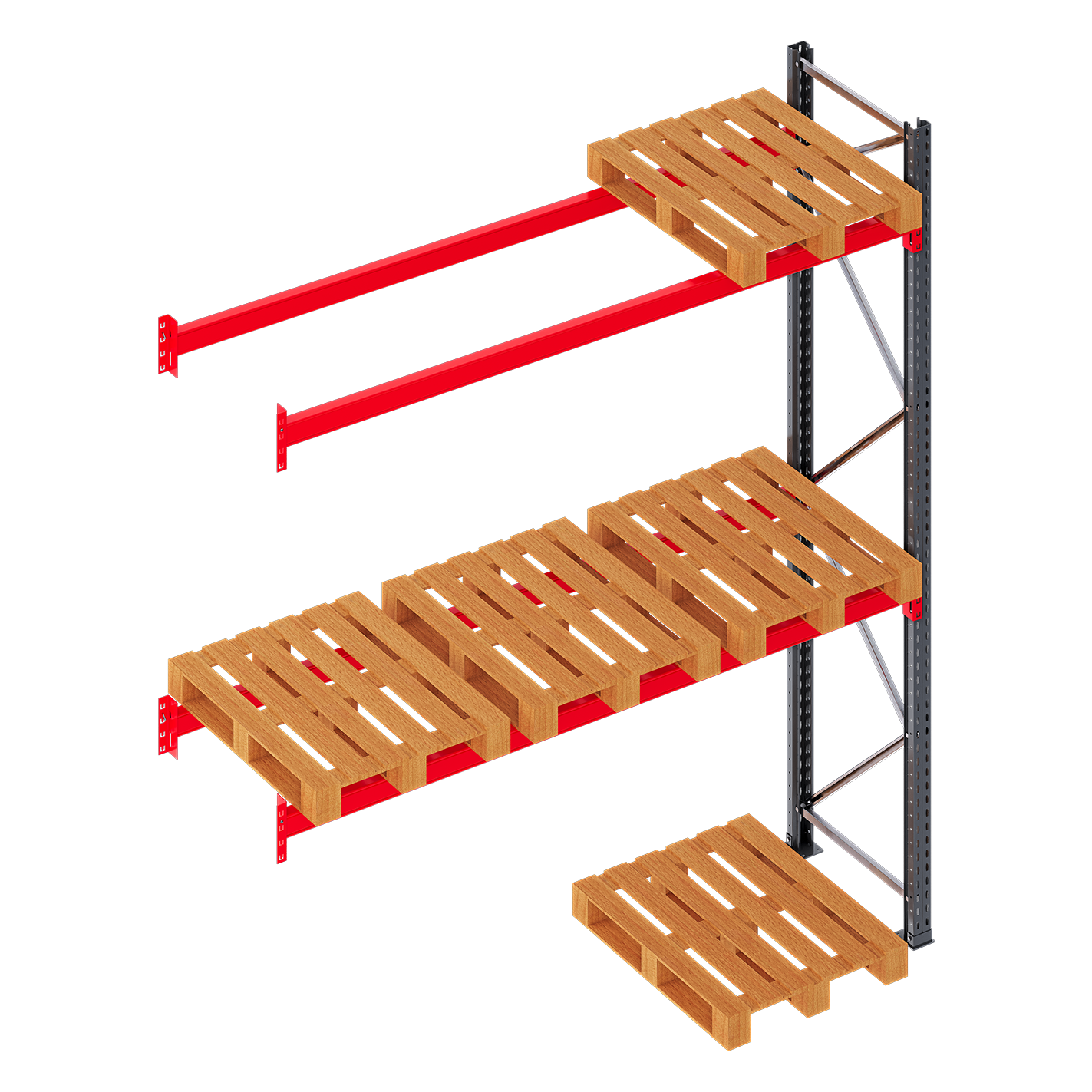
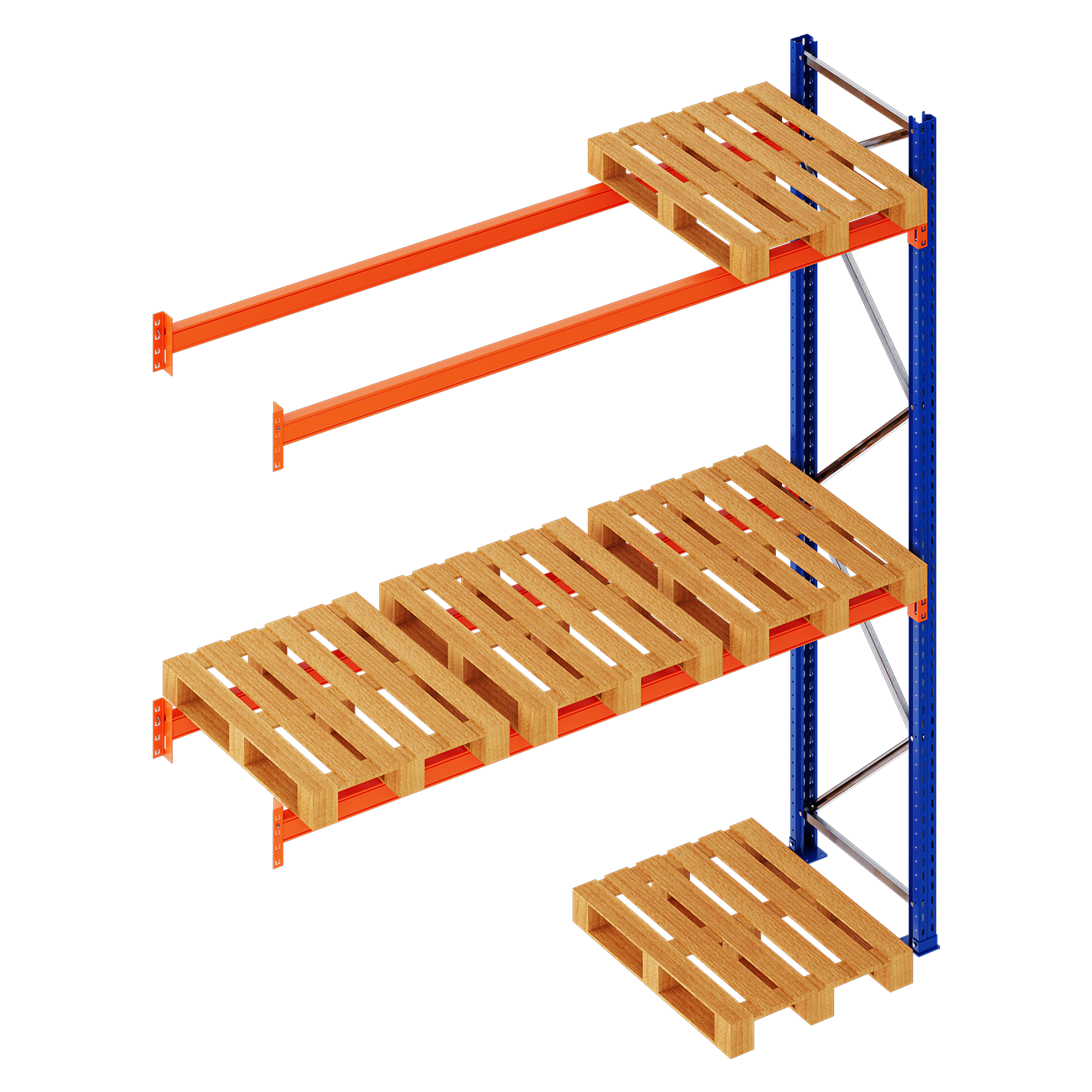
Commonly known as the Extension Bay, this unit consists of one upright frame and a set  of beams. Unlike the Main Bay, it cannot stand alone or be used as the first unit in a run.  Instead, it is designed to connect directly to a Main Bay, forming a seamless extension.  While the depth of the Add-on Bay must match that of the Main Bay, its height and length  may be adjusted to suit specific requirements.

Calculating How Many Bays Do I Need?

Main Bay

Because main bays are the only units that can stand alone, you will need one for every run. To determine the total number of main bays that can be accommodated, first review the layout to confirm the overall storage depth available, accounting for the required clearances on all sides. Next, finalise the rack depth to be used.


If there are pillars or columns in the facility, the rack run should stop before the pillar with the required clearances. After the pillar, the run can continue by starting again with a Main Bay, keeping the same spacing in mind.


An example, if the available storage depth is 18,000 mm (18 m) and the selected rack depth is 800 mm, we must also consider the clearance required for the Material Handling Equipment (MHE). Assuming a forklift is in use, an aisle width of 3,200 mm is required between two rack runs.
Each rack run requires 800 mm (rack depth) + 3,200 mm (aisle clearance), except at the outermost racks, which only require the rack depth without additional clearance behind them.


For 5 rack runs (main bays):


  • Total rack depth = 5 × 800 mm = 4,000 mm

  • Total aisle space = 4 × 3,200 mm = 12,800 mm

  • Combined depth requirement = 16,800 mm, which fits within the available 18,000 mm.

Adding a 6th rack run (main bay) would require an additional 3,200 mm (aisle) + 800 mm (rack depth) = 4,000 mm, increasing the total depth to 20,800 mm, which exceeds the available storage depth.

Add-on Bays:


When planning for add-on bays in a continuous run, the calculation differs slightly from main bays and requires careful evaluation of the available layout. Begin by confirming the total length of the area available for racking (accounting for the required clearances), and then finalize the rack length.


For example, if the available floor length is 25,000 mm (25 m) and the chosen rack length is 2,300 mm, the first unit will be a Main Bay, which occupies one rack length. This leaves a residual space of: 25,000 mm – 2,300 mm = 22,700 mm Within this remaining space, only add-on bays can be placed.


With 9 add-on bays:


Total length = 9 × 2,300 mm = 20,700 mm, which fits within the available 22,700 mm.


With10 add-on bays:


Total length = 10 × 2,300 mm = 23,000 mm, which exceeds the available space.

Therefore, the maximum configurations for this layout is 1 main bay + 9 add-on bays, making a total of 10 bays in the run.

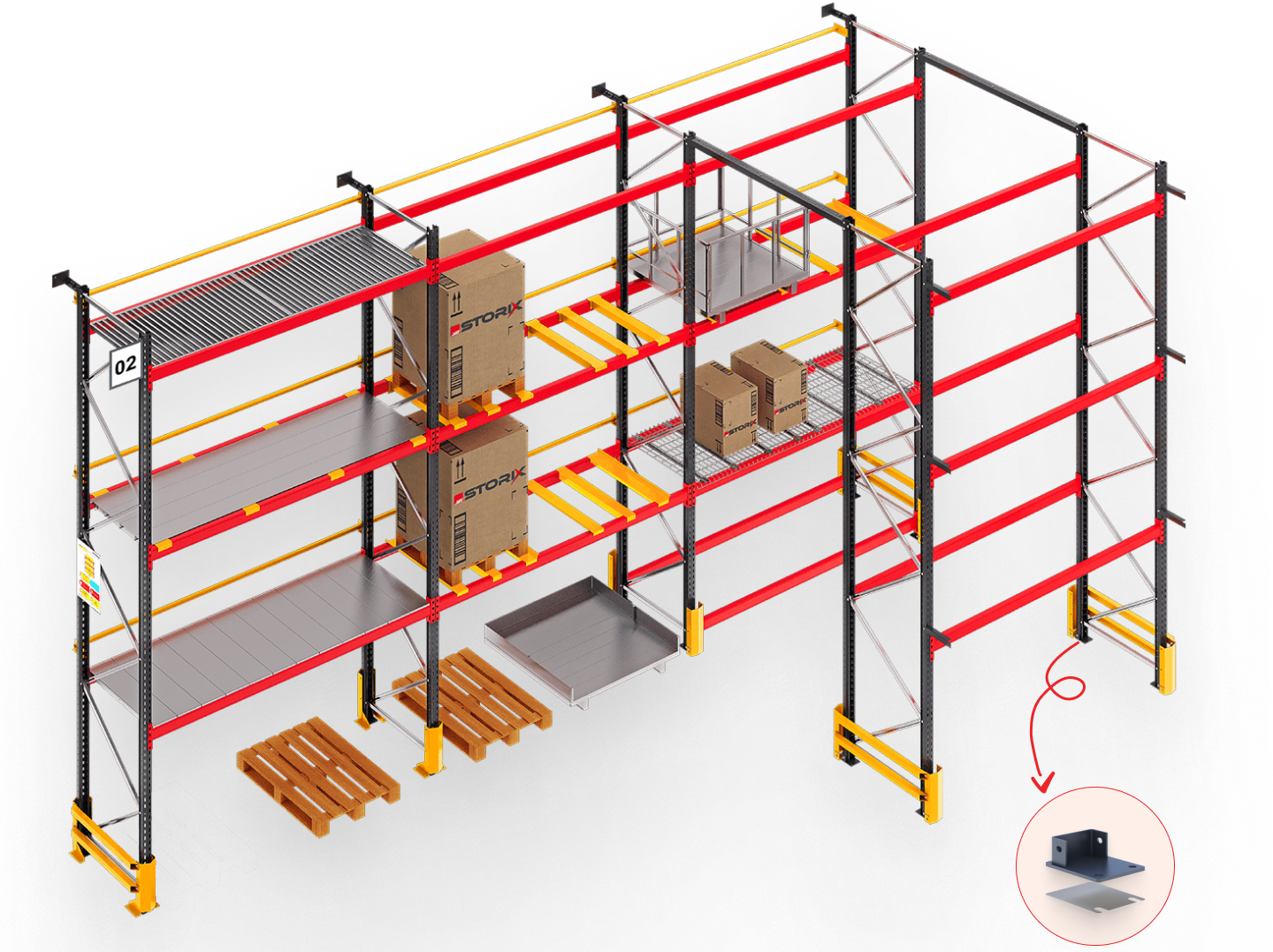
The Complete PalletMax Rack

A complete pallet rack main bay is made up of at least two upright frames and four load beams. Additional bays can be attached using two beams, which are suspended between the upright frames. These beams are secured with locking pins to prevent accidental dislodging. The upright frames are reinforced with diagonal and horizontal braces made of galvanised C-profiles. For extra stability, the load beams can be connected using depth bars, and the length of the beams defines the bay length.


Because of their high load capacity, pallet racks must always be anchored to the warehouse floor using special floor anchors. Anchoring prevents racks from tipping over and ensures that their original alignment is maintained. In large installations, racks are exposed to continuous forces from frequent loading and unloading operations, which can cause gradual movement over time. By securing the racks with floor anchors, this movement is eliminated, and the system remains firmly in place.

01

Frame — Vertical structure that supports
beams and holds the racking system. It
is made with vertical components called
uprights.

02

Horizontal & Diagonal Bracing —
Provides lateral stability to
prevent racking from swaying,
and connects the 2 uprights together.

03
  1. Load Beam — Horizontal component
    that supports the load (i.e. pallets).
  2. Lock Pin — Secures beams to the frame
    to prevent dislodging.
05

Aisle Identification Board — Labels aisles
for easy identification and organisation.

06
Rack Load Notice — Displays the load capacity
of the racking system to ensure safe usage.
07

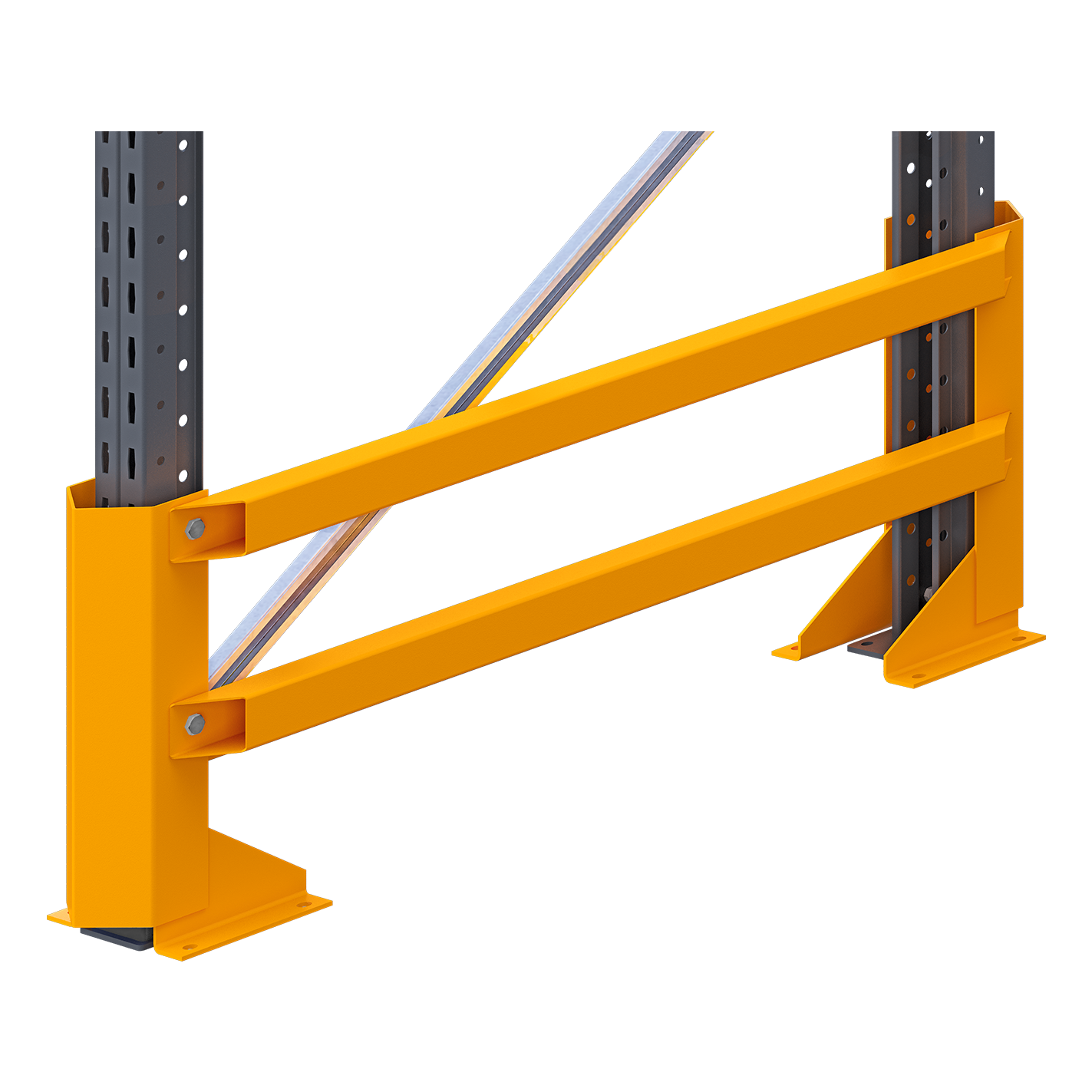
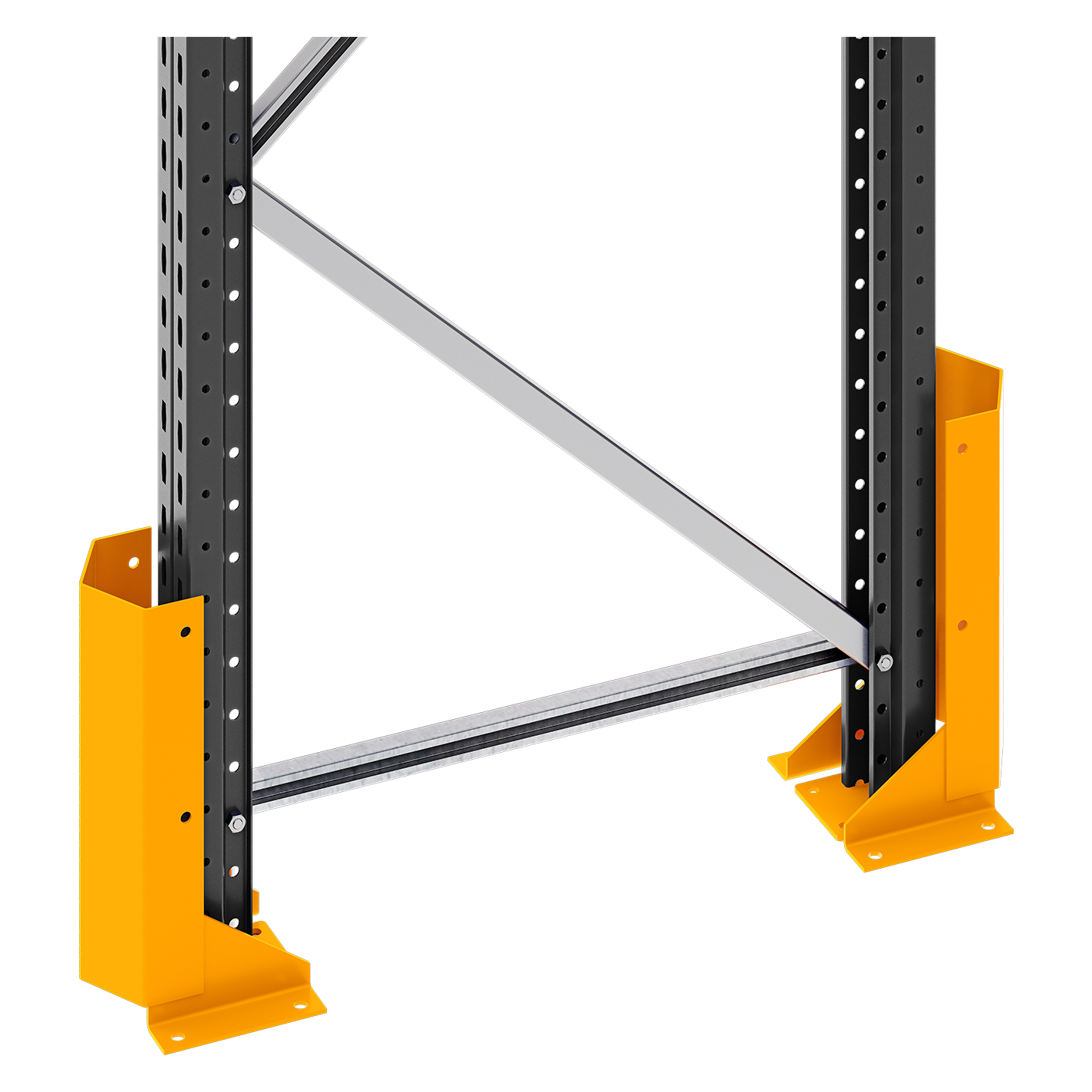
Upright Guard — Protects each upright
from damage due to forklifts or other equipment.
It is of 2 types — U-shaped & L-shaped,
both of these serve the same purpose
 but have different considerations.

08

Frame Guard — Protects each frame
from damage due to forklifts or other equipment.
It is of 2 types — U-shaped & L-shaped,
both of these serve the same purpose
but have different considerations.

09

Row Spacer — Maintains distance
between racks, ensuring stability.

10

Top Tie Beam — Connects frames at the top,
adding stability and preventing flexing.

11

Wall Connector — It is a metal component
used to anchor or connect the racking
structure to a nearby wall for extra
stability and safety

12

Welded Pallet Support Bar —
It is a safety and load support accessory
that supports pallets across the beam.

13

Z Type Pallet Support Bar —
It is a safety and load support accessory
that supports pallets across the beam. It
also acts a guide while placing pallets
to avoid any incidents.

14

Panel Type Pallet Support Bar —
It is a safety and load support accessory
that supports pallets across the beam.

15

Welded Panel Support Bar —
It is a safety and panel support accessory
that supports various decks across the beam.

16

Pallet Stopper — Prevents items from
falling off the back of the rack.

17

Levelling Shims — Corrects any unevenness in the floor,
ensuring the rack is level. The upright leg is placed on the shim.

18

Upright Leg — or a Footplate. This is where the upright rests upon.
The leg is anchored into the floor to ensure sturdiness.

19

Panel — Panels are placed on the beams that
provide acontinuous surface for irregular shaped
items, loose items, or different /odd shaped pallets.
About Frames & Beams

Frames:

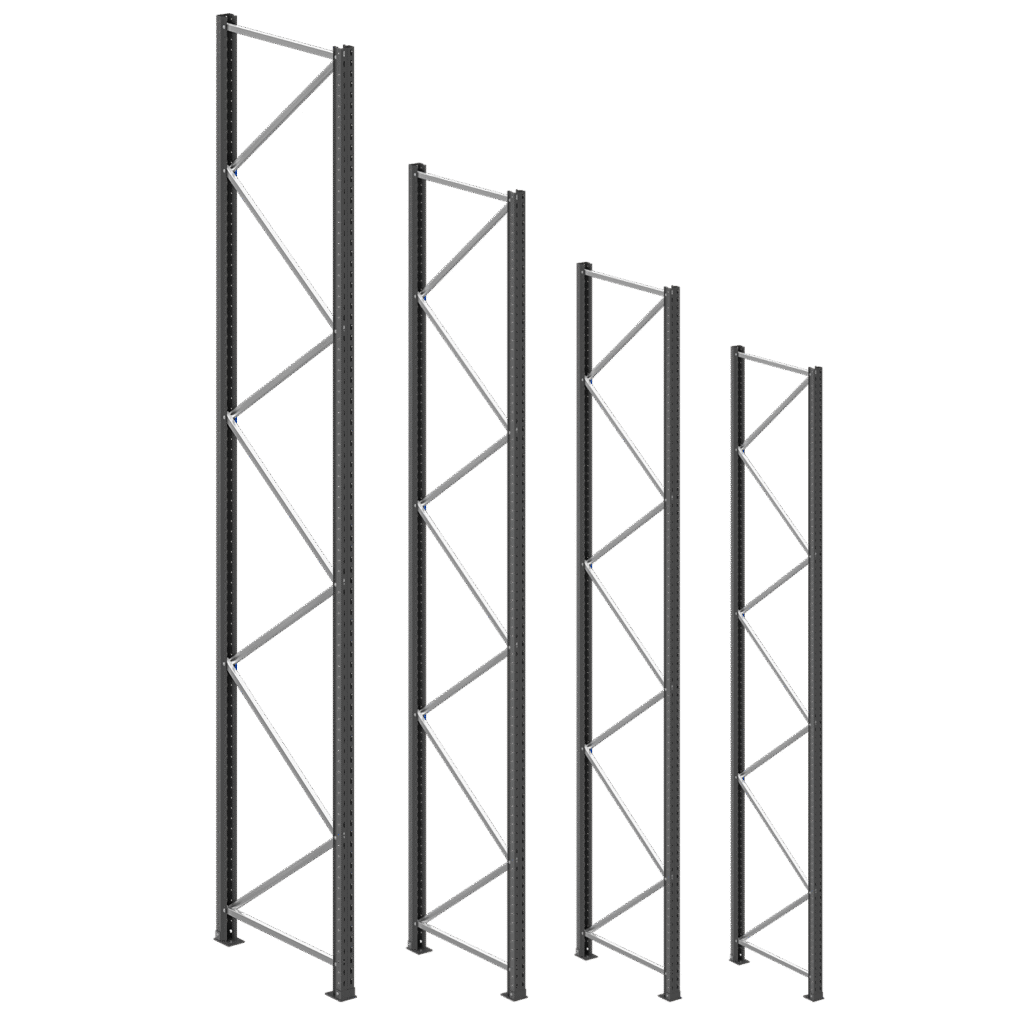
The Frame Depth of the PalletMax Rack has 2 variants — Depth of 800mm and 1000mm.


A Frame with 1000mm Depth is widely used since it easily accommodates euro pallets storage.


A lateral storage of pallets is possible, but only with the help of Pallet Support Bars, or 4B Panels with Welded Panel Support Bars.

  • We do not recommend storing pallets on frames with an overhang of 150mm or more on either side.
  • When the pallet has an overhang of about 100 mm on each side, pallet support bars are not strictly required, though they may still be used if you wish to — any type of
    pallet support bar can be used in this case.
  • For pallets with the same depth as the rack, a Z-Type Pallet Support Bar or a Panel-Type Pallet Support Bar should be used.
  • For pallets with a depth smaller than the rack, a Welded Pallet Support Bar must be used.


The Frames of the PalletMax Rack have 7 heights — 3m, 3.5m, 4m, 4.5m, 5m, 5.5m, 6m. The number of levels you can have depends on 2 factors: load per level, & the height of the frame. Check the table to see how many levels will fit your needs:

The number of levels in a rack can be maximised as long as the Total Rack Load remains  within the bay’s capacity. Our racks are designed to carry up to 9,000 kgs per bay, with  each level capable of supporting a maximum of 2,000 kgs.  

Number of Levels Possible Height Wise Table
Frame Height 2 Levels 3 Levels 4 Levels 5 Levels
3,000mm Yes Yes
3,500mm Yes Yes Yes
4,000mm Yes Yes Yes
4,500mm Yes Yes
5,000mm Yes Yes Yes
5,5000mm Yes Yes Yes
6,000mm Yes Yes Yes

Beams:

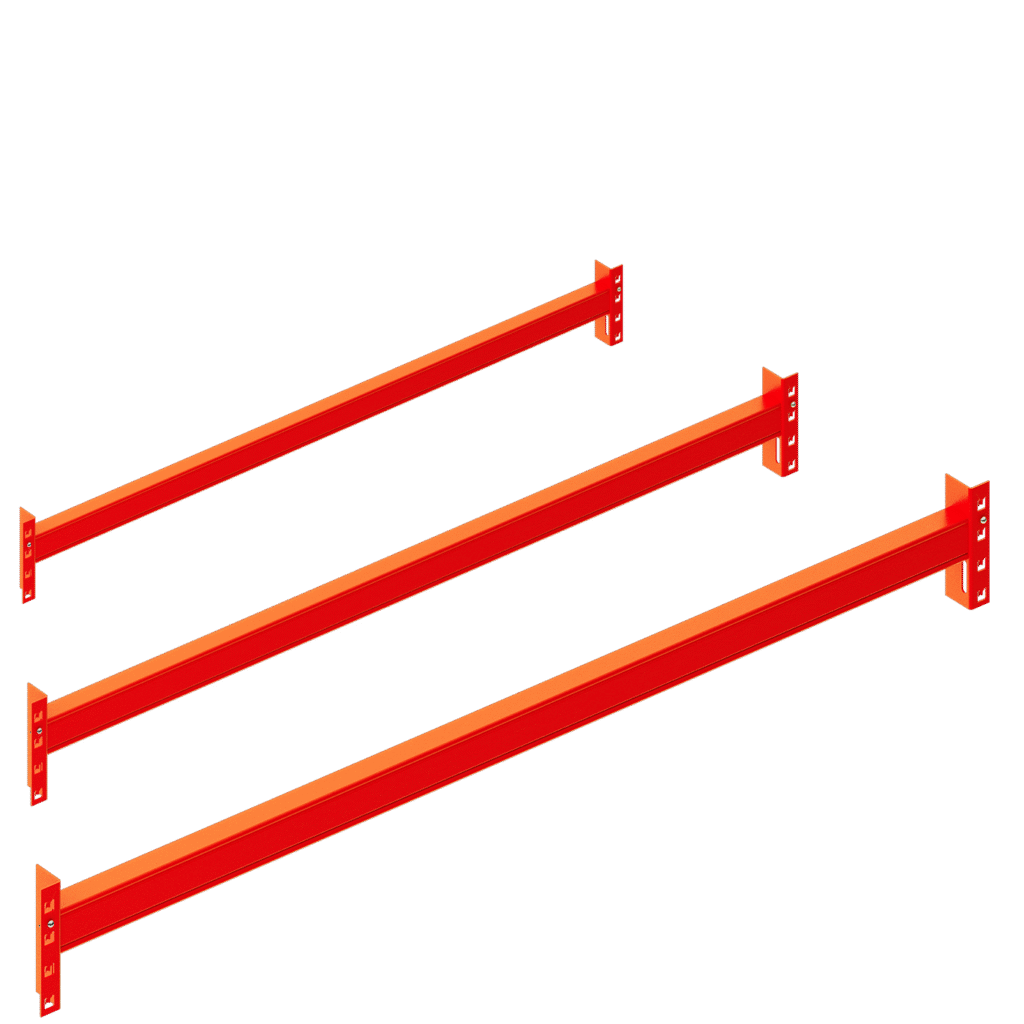
The PalletMax Rack is designed to have 3 different Rack Lengths — 1900mm, 2300mm, &  2700mm.  


The maximum level-to-level height is 1500mm. Increasing this any further will decrease  the load carrying capacity, substantially. At the same time, decreasing level-to-level height  will briefly increase the load carrying capacity – although this is strongly not  recommended by us. If you still wish to add more levels, you can always purchase extra  beams by clicking here.  


Note: Always ensure that the highest level is positioned at least 500mm below the top  edge of the upright frame. This safety clearance prevents stored goods from slipping  sideways over the top of the rack. It is mandatory for all racks that are facing aisles or  exposed to traffic routes — where movement and people are present. It is not required  for racks positioned back-to-back within a continuous row since no people are present  and goods cannot fall sideways to the next frame.  


Failure to observe this rule may result in falling goods and increased risk of accidents.  


Regardless of the rack length or load-per-level combination selected, it is essential to  ensure proper load distribution along the beam. We recommend maintaining a clearance  of 100 mm at the rack corners for pallet positioning, along with a 100 mm gap between  the pallets. In cases where pallet dimensions allow for three pallets per level, the pallet to-pallet gap may be adjusted to 80 mm. The reference table below provides guidance  on how many pallets can be accommodated for each rack length.  


For different loads per level, we have different profiles of beams available. These profiles  change as per thickness and dimensions.  

Beams — Length wise No. Of Pallets Distribution
Pallet Size Rack Length = 1900mm Rack Length = 2300mm Rack Length = 2700mm
800L x 1000D 2 Pallets per Level 2 Pallets per Level 2 Pallets per Level
800L x 1200D 2 Pallets per Level 2 Pallets per Level 2 Pallets per Level
1000L x 1000D 2 Pallets per Level 2 Pallets per Level
1000L x 1200D 2 Pallets per Level 2 Pallets per Level
1200L x 1000D 2 Pallets per Level
1200L x 1200D 2 Pallets per Level

Before You Begin

Before placing your order, please review the following essential guidelines.

This will help you avoid mistakes, delays, and any confusion during the purchase process.

Please have the following information ready:

  • Accurate Measurements of your storage area.
  • Dimensions & Weight of Goods, which determine the required load capacity per level.

Once you have these points ready, you can move on to planning your complete layout.

How to Determine the appropriate dimensions for your facility?

Determining the right rack dimensions for your space is straightforward. Simply measure the available area and select the rack dimensions that match it. The dimensions you choose will correspond closely to the space you need, with an additional 100 mm added to the total length and depth for ease of placement. Since FoldRivet is designed for manual operations, there’s no need to account for extra clearance or manoeuvring space, making it easy to plan and utilise your storage area efficiently.

Recommended Floor Clearance:

  • General flatness: Maximum deviation of 4 mm, measured over any two survey points.
  • Floor slope: Maximum 1 in 500 (≈2 mm per meter).
  • Point Loads: each post carries upto 25-75Kgs depending on rack height, shelf load, and configuration.

The Complete FoldRivet Rack

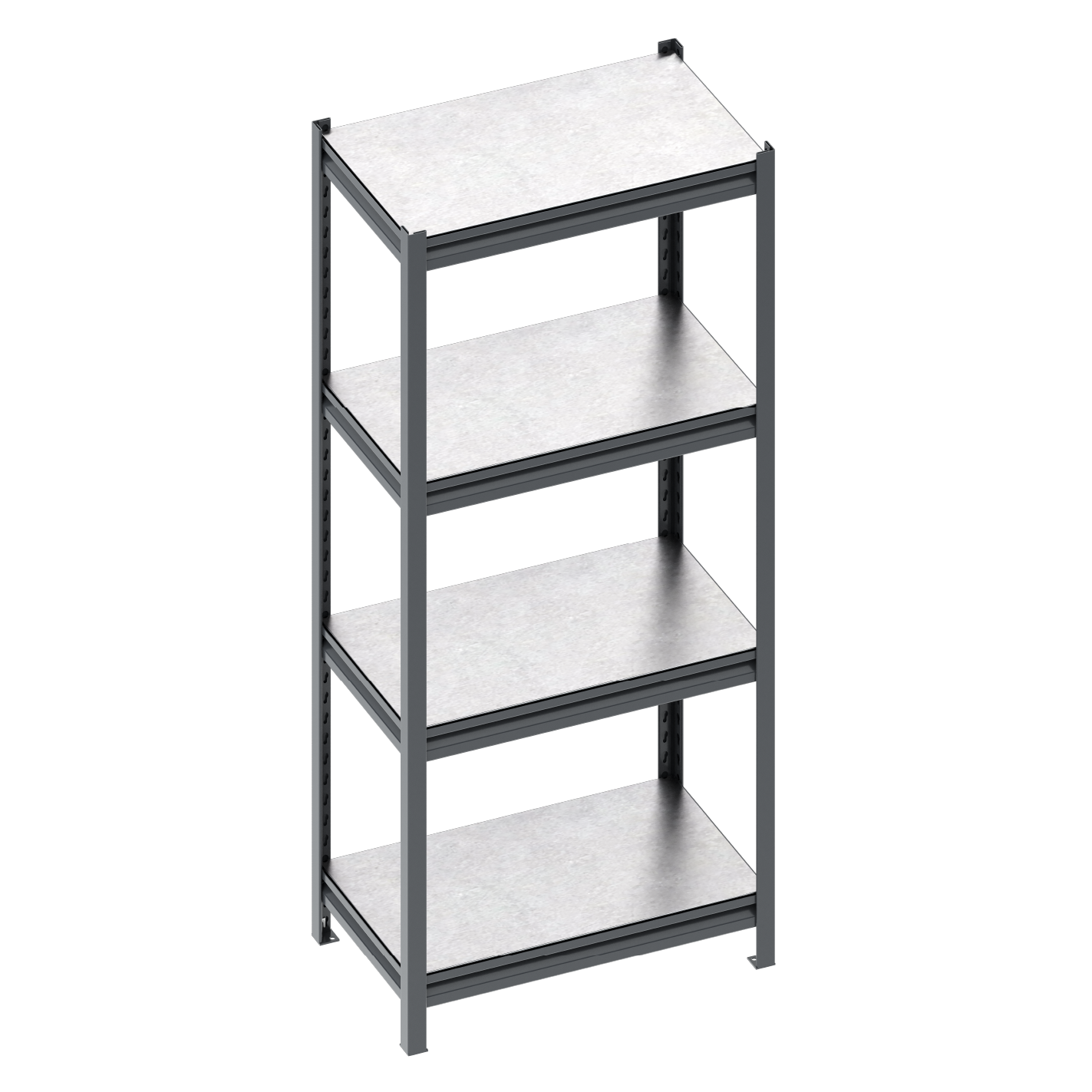
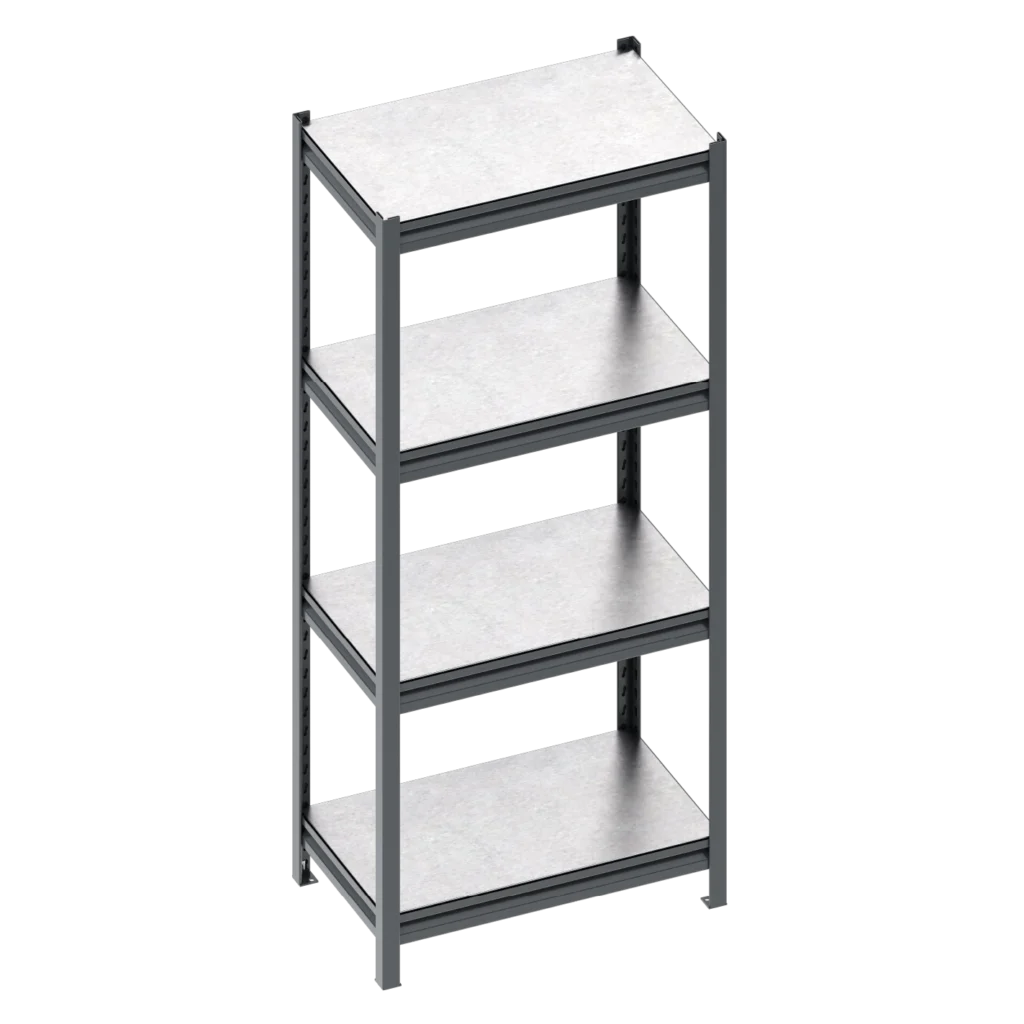
A complete FoldRivet is built using four angles as the vertical framework, with beams running across both the length and depth at every level. Panels are then placed on top of the beams to form the shelving surface, creating a stable and functional storage system.

01

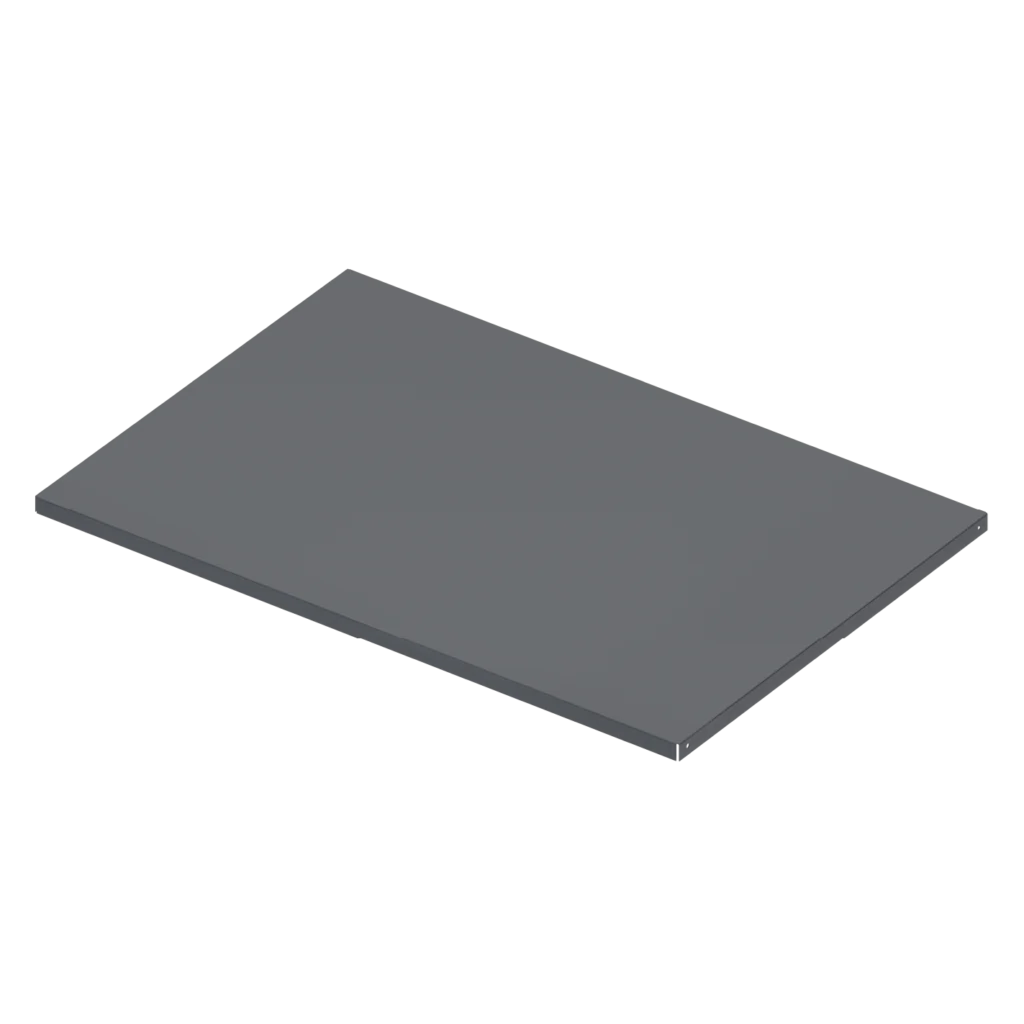
Panel: Panels provide the flat surface for storing items, designed
to fit securely between angles and beams. Some panels include
stiffeners for extra support, ensuring that light- to medium-weight
loads remain safe and stable.

02

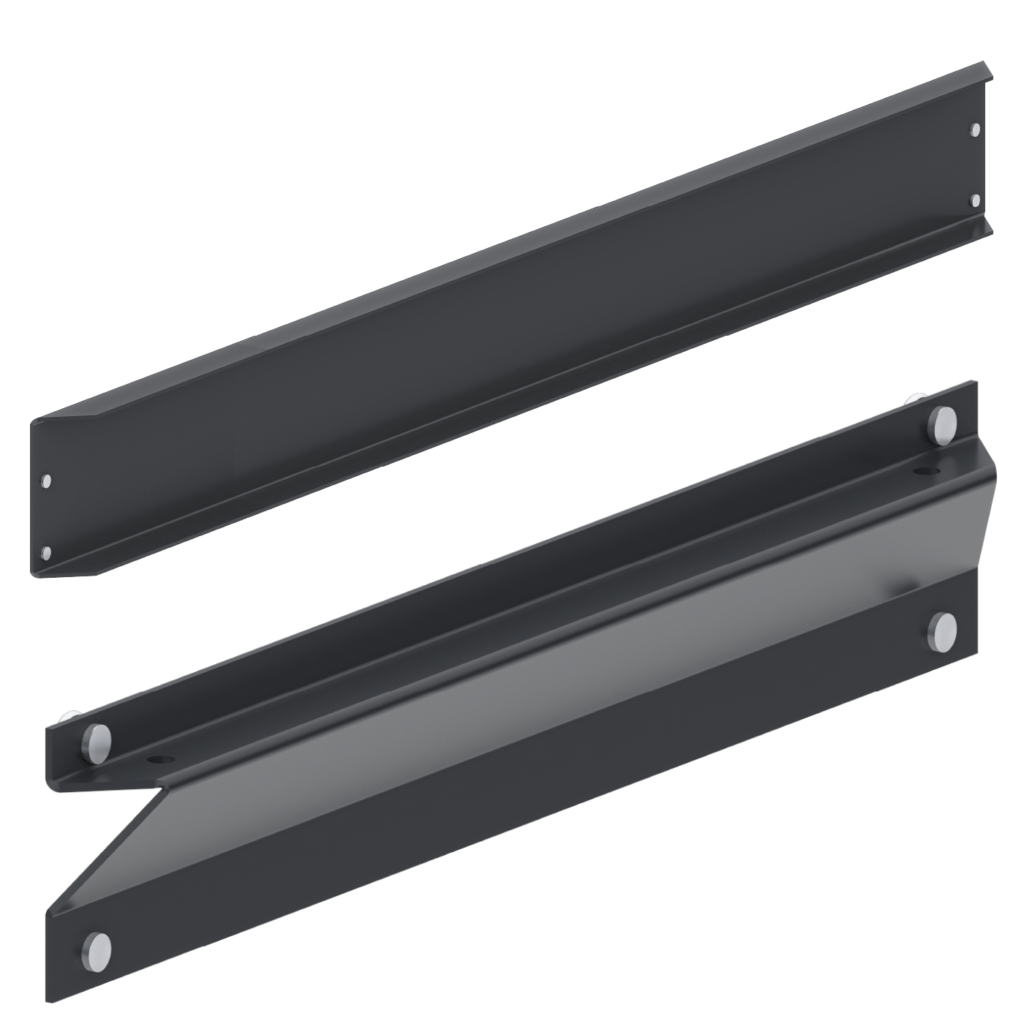
Beam: Beams, available in Z and C profiles, support the shelves
horizontally across the rack. Z beams are ideal for standard configurations,
while C beams are used for taller or deeper racks
with cross supports, offering enhanced rigidity and load-bearing capacity.

03

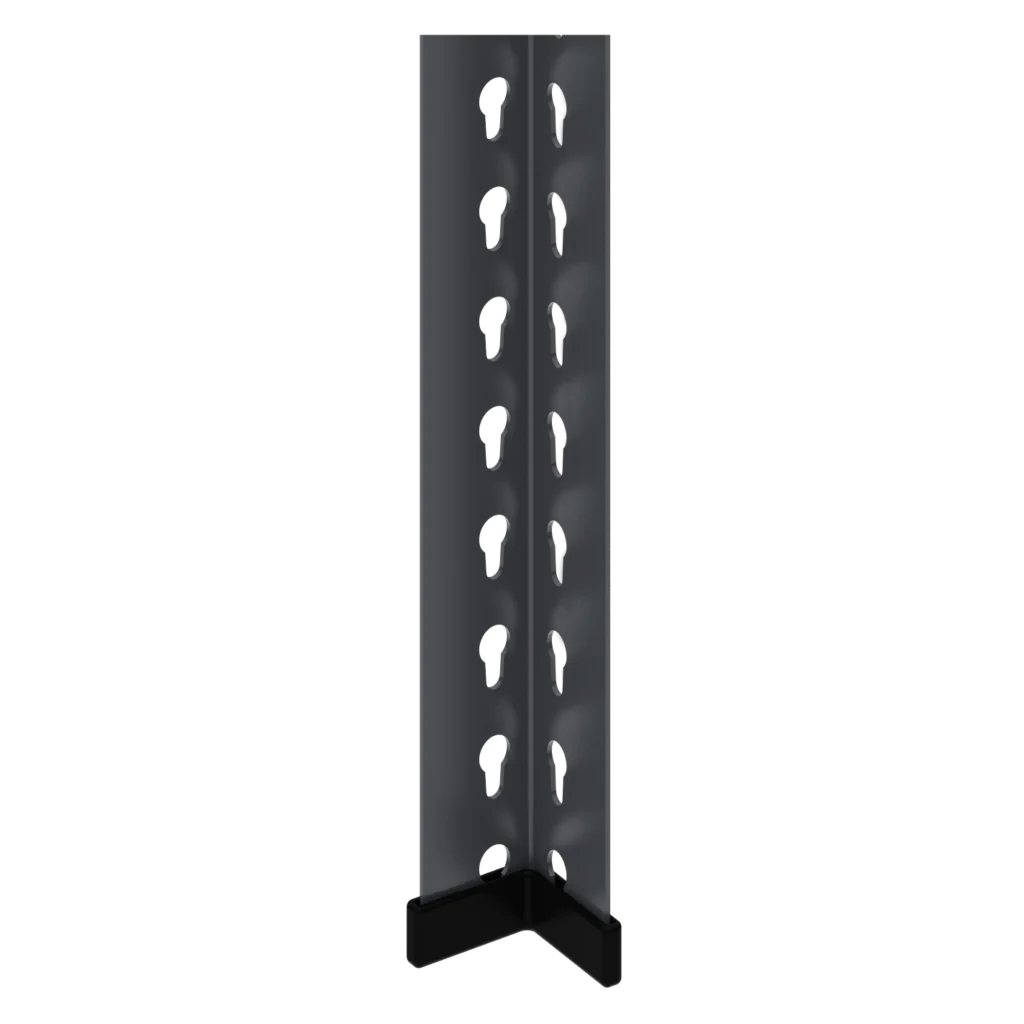
Angle: folded angles feature internal keyhole punches and a folded
top layer for a clean finish and superior durability.
They provide the vertical framework of the rack, offering strength,
rigidity, and long-term reliability for heavier or more frequent use.

04

Baseplate: The baseplate serves as a sturdy foundation for the rack,
distributing weight evenly and enhancing stability. It ensures that your
angles remain upright and secure, even under medium-weight loads.
01
02
03
04
01. Panel

Panel: Panels provide the flat surface for storing items, designed to fit securely between angles and beams. Some panels include stiffeners for extra support, ensuring that light- to medium-weight loads remain safe and stable.

Beam: Beams, available in Z and C profiles, support the shelves horizontally across the rack. Z beams are ideal for standard configurations, while C beams are used for taller or deeper racks with cross supports, offering enhanced rigidity and load-bearing capacity.

Angle: folded angles feature internal keyhole punches and a folded top layer for a clean finish and superior durability. They provide the vertical framework of the rack, offering strength, rigidity, and long-term reliability for heavier or more frequent use.

Baseplate: The baseplate serves as a sturdy foundation for the rack, distributing weight evenly and enhancing stability. It ensures that your angles remain upright and secure, even under medium-weight loads.
About the Angles, Beams & Panels

The Angles:

FoldRivet angles feature keyhole punches on the inside for easy assembly, with an additional folded layer along the top edge that enhances durability and provides a clean, polished finish. This design makes FoldRivet angles stronger and more resistant to wear and bending, making them ideal for higher-frequency use or heavier loads. Multiple angle lengths are available to customise the rack height according to your storage requirements.

Rack Heights available are: 912 mm, 1216 mm, 1520 mm, 1824 mm, 2432 mm, 2736 mm, 3040 mm, 3648 mm.

The Beams:

The beams in FoldRivet come in two profiles: Z beams and C beams. Z beams are suitable for standard configurations, offering robust horizontal support for everyday storage needs. C beams are designed for higher or deeper racks, incorporating cross supports along the depth to enhance rigidity and prevent sagging. Beam lengths are versatile, supporting both the width and depth of the rack to provide a secure, stable platform for your stored items.

Rack Lengths available are: 600 mm, 750 mm, 900 mm, 1000 mm, 1200 mm, 1500 mm, 1800 mm, 2000 mm, 2400 mm.

Rack Depths available are: 300 mm, 450 mm, 600 mm, 750 mm, 900 mm.

The Panels:

FoldRivet panels are uniform throughout the system and designed to integrate seamlessly with the angles and beams. These steel panels provide a durable, flat surface for storing items of various sizes and weights. Some panels come with additional stiffeners for extra support, ensuring that even medium-weight loads remain secure and stable.

For various Rack Lengths, different numbers of panels are used for each level. As per the dimensions entered, you will be provided with the right panels in your order!

Panel Lengths available are: 600mm, 750mm, 900mm, & 1000mm.

Panel Depths available are: 300mm, 450mm, 600mm, 750mm, & 900mm.

Loads supported on each level: 100Kgs, 200Kgs, & 300Kgs.

Rack Height No. Of Levels
912 mm 3 / 4 / 5
1216 mm 3 / 4 / 5 / 6
1520 mm 3 / 4 / 5 / 6 / 7
1824 mm 3 / 4 / 5 / 6 / 7 / 8
2128 mm 4 / 5 / 6 / 7 / 8
2432 mm 4 / 5 / 6 / 7 / 8
2736 mm 5 / 6 / 7 / 8
3040 mm 5 / 6 / 7 / 8 / 9 / 10
3648 mm 5 / 6 / 7 / 8 / 9 / 10

Frequently Asked Questions

What Can be Stored?

The FoldRivet is perfect for a variety of everyday items, offering enhanced strength for slightly heavier loads. It can store kitchenware, small appliances, packaged food, retail merchandise, cleaning supplies, craft materials, or lightweight hardware. Its reinforced folded frame ensures that items remain secure, while the open shelving and modular design make it easy to organise, access, and rearrange goods according to your evolving storage needs.

Your order will take at least 6 days to process plus the additional time taken for delivery shown at your checkout when it is finalised. In many cases, the processing time can change too.

You will need a team of 4-7 people. 1 Rack usually takes forty minutes depending on the skillset and tools used.

Four Angles are needed for one rack.

Two Beams are needed to cover the Rack Depth, and two Beams are needed to cover the Rack Length.

For Rack Lengths 600 mm to 1000 mm, one panel is needed for each level. Then from Rack Lengths 1200 mm to 2000 mm, two panels are needed for each level. For Rack Length of 2400 mm, 6 panels of 600 mm are needed.

While ordering a simple rack, you will be provided with the required quantities of the main components (four angles, the correct number of panels needed based on the number of levels selected, and four beams for each level). All the necessary hardwares and fasteners are also provided in the required quantities to secure the mentioned components.

Along with these main components, any extra component added in your order will also be sent with its required fasteners.

No tools will be provided and we may provide extra fasteners in our kits.

Of course, all the assembly instructions and user manuals are also provided. A digital copy of the same will be available for you in your account as a backup too.

Absolutely. We know that choosing the right rack system can feel overwhelming.You can explore our support and design services here to get step-by-step assistance.

Our support team is available Monday to Friday, 9:00 AM to 5:00 PM (IST). You can reach us at support@jaystorix.online, and we’ll get back to you promptly.

Once a product has been shipped, cancellations and returns are not accepted. For full details, please review our policies here.

Our Promise

At Storix, we prioritise earning our customers’ trust through superior design, quality, and safety in every aspect of our FR systems. Our solutions incorporate carefully designed components, that ensure efficient storage and ease of use. We follow the highest design standards to maximise space utilisation while prioritising operator safety, creating systems that are both reliable & user-friendly, and also safe for the environment.

Installation is seamless and hassle-free, allowing customers to experience immediate benefits without unnecessary delays. Our premium quality lead-free powder coating enhances durability, ensuring a longer product life while maintaining exceptional performance under rigorous conditions. With Storix, customers can trust in a system that delivers unmatched reliability, safety, and convenience.

Choice Shipping Address

×

You have no shipping addressesÅ›.